An overview
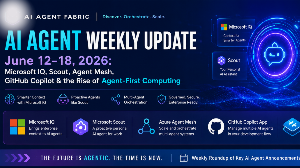
The AI agent industry continues to evolve at an extraordinary pace. While much of the attention over the past year has focused on model capabilities, this week highlighted something equally important: the infrastructure required to make AI agents useful at scale.
Across Microsoft Build 2026 and other major industry announcements, the focus shifted toward context management, orchestration frameworks, governance, and agent-native platforms. The industry appears to be entering a new phase where the success of AI agents will depend less on raw model intelligence and more on how effectively agents can operate across real-world systems.
Here are ten important developments that shaped the AI agent ecosystem this week.
1. Microsoft introduces microsoft iq for enterprise context
One of the most significant announcements from Microsoft Build 2026 was Microsoft IQ, a new context layer designed to provide AI agents with a deeper understanding of enterprise data, workplace knowledge, and organizational relationships.
Context has become one of the biggest challenges in enterprise AI. Even the most capable models struggle when they lack access to organizational knowledge. Microsoft IQ aims to solve this problem by giving agents richer context, enabling them to make better decisions and execute tasks more effectively.
This announcement signals a broader industry trend: context is becoming just as important as model intelligence.
2. Github launches an agent-native copilot app
GitHub introduced a new Copilot desktop application designed around agent-native workflows. Instead of simply helping developers write code, the application allows multiple AI agents to work on different development tasks simultaneously.
Developers can assign issues, review outputs, and supervise execution while agents handle coding, testing, debugging, and implementation work. This represents a significant evolution from code completion toward autonomous software development assistance.
The future of software engineering is increasingly becoming a collaboration between human developers and specialized coding agents.
3. Windows becomes an ai agent platform
Microsoft also revealed plans to position Windows as a platform for AI agents rather than simply an operating system for applications.
This vision allows agents to interact with files, applications, enterprise systems, and cloud services through standardized interfaces. By embedding agent capabilities directly into the operating environment, Microsoft hopes to create a more seamless and powerful AI experience.
The move reflects a growing belief that future computing experiences will revolve around agents rather than traditional applications.
4. Project solara introduces agent-first devices
Microsoft unveiled Project Solara, a chip-to-cloud platform designed specifically for a new generation of enterprise devices powered by AI agents.
Unlike traditional devices that revolve around apps, Solara devices are designed around agents capable of understanding user intent and executing tasks across multiple systems. This approach could significantly reshape frontline work, field services, healthcare operations, and enterprise productivity.
The announcement demonstrates that agentic AI is expanding beyond software into hardware ecosystems.
5. Azure agent mesh expands multi-agent orchestration
Microsoft introduced Azure Agent Mesh, a framework designed to help organizations coordinate multiple AI agents across cloud, edge, and enterprise environments.
As companies deploy increasing numbers of specialized agents, orchestration becomes essential. Agent Mesh allows organizations to manage collaboration between planning agents, execution agents, monitoring agents, and validation agents.
This reflects a growing industry consensus that the future belongs to multi-agent systems rather than isolated AI models.
6. Microsoft agent framework reaches enterprise readiness
Microsoft also expanded its Agent Framework, providing developers with production-ready tools for building enterprise-grade AI agents.
The framework includes support for memory, orchestration, context management, governance, and execution monitoring. These capabilities are critical for organizations looking to deploy AI agents safely and reliably at scale.
Enterprise adoption increasingly depends on robust frameworks rather than standalone models.
7. Agent governance and observability gain momentum
One of the strongest themes this week was governance. Organizations are increasingly focused on understanding how agents make decisions, what actions they take, and how they interact with business systems.
As AI agents become more autonomous, observability, auditability, and compliance are becoming non-negotiable requirements. Enterprises want visibility into every decision and action taken by autonomous systems.
This shift highlights the growing maturity of the AI agent market.
8. AI coding agents continue their rapid growth
AI coding agents continue to evolve from simple code assistants into autonomous development partners capable of planning, coding, testing, and debugging software.
This week’s announcements reinforced the idea that software development may become one of the earliest industries to experience large-scale agent adoption. Organizations are increasingly using agents to accelerate development cycles while allowing engineers to focus on higher-level architecture and problem-solving.
The role of developers is evolving from writing every line of code to supervising intelligent systems.
9. Context becomes the new competitive advantage
Across nearly every announcement this week, one theme emerged repeatedly: context.
The next generation of AI agents will not be defined solely by reasoning capabilities. Instead, their effectiveness will depend on how well they understand organizational data, business processes, relationships, and objectives.
Companies that solve the context problem may gain a significant advantage in the race to deploy useful AI agents.
10. The agentic technology stack takes shape
The broader AI ecosystem is beginning to converge around a common set of layers required for agentic systems.
These layers include identity management, orchestration, governance, memory, context, communication protocols, and execution frameworks. Together, they form the foundation of what many are calling the "Agentic Stack."
The industry is gradually moving from experimentation toward a structured technology ecosystem designed specifically for autonomous systems.
Final Takeaway
This week demonstrated that the AI agent industry is entering a new phase.
The conversation is shifting away from model benchmarks and toward the infrastructure required to deploy agents at scale. Context, orchestration, governance, and observability are becoming critical priorities for organizations building agentic systems.
The question is no longer:
"How intelligent is the model?"
Instead, organizations are asking:
"How effectively can AI agents understand context, coordinate with other agents, and execute work across real systems?"
That transition will likely define the next generation of enterprise software and the future of agentic AI.


